
Introduction
I have worked in software development across both the game industry and the blockchain industry for many years. From that experience, one thing I have found especially interesting is that although game applications, Web2 applications, and Web3 applications all follow the same broad software development lifecycle, the way they feel in practice can be very different.
In this article, I want to share those differences through a simple structure: the development cycle itself.
I will use Web2 as the baseline, because for many engineers it is the most familiar model. Then I will introduce the development cycle of games and Web3 applications stage by stage, following the same flow: requirements, system design, implementation, testing, deployment, and monitoring.
This article is not meant to say that one domain is better than another. It is also not meant to claim that every company works in exactly the same way. My game industry experience comes from working in two companies, and other studios may have different processes, tools, and release models. The same is true for Web3: the workflow can vary a lot depending on whether the product is a wallet, an NFT platform, a DeFi system, a gaming ecosystem, or an infrastructure project.
What I want to share here is something more practical: when you move between these domains, even if the stage names stay the same, the engineering mindset changes. The priorities change. The constraints change. The risks change. And because of that, the way we design, build, test, and operate the software also changes.
So rather than comparing them only at a high level, I want to walk through the cycle itself and show where the differences really appear.
Web2: the baseline development cycle
Before talking about games and Web3, it is helpful to briefly describe the development cycle of a typical Web2 application. Here, by Web2, I mean common internet applications such as SaaS products, admin systems, e-commerce platforms, marketplaces, content platforms, and internal business systems.
Although different companies have different processes, the overall lifecycle is usually familiar: requirements, system design, implementation, testing, deployment, and monitoring. What makes Web2 a useful baseline is that, for many engineers, it represents the most standard software delivery model.
Requirements of features
In Web2, features are usually driven by business goals and user workflows.
A team may plan work by quarter, month, or sprint, but the core questions are often similar: what problem are we solving, which users are affected, how does this improve the business, and how should we measure success?
For example, a Web2 team may build features to improve signup conversion, simplify payment flows, reduce manual work for operators, support team collaboration, or increase retention. The focus is usually less about “content” in the way games think about content, and more about reducing friction and improving the efficiency of a user journey.
Another common characteristic of Web2 is that features are often released incrementally. Instead of preparing a very large release and waiting for a single launch point, teams often break work into smaller steps, ship earlier, gather feedback, and refine from there.
Solution (system design)
At the system design stage, a typical Web2 application is usually built around stateless HTTP request-response flows.
The database is commonly the source of truth. Around it, the system may include Redis for caching, a queue for asynchronous jobs, object storage for files, a search engine for advanced queries, and a CDN for static assets. This is a very common architectural pattern because it supports scalability, maintainability, and relatively clear service boundaries.
Authentication is usually platform-managed. Users log in with email and password, SSO, OAuth, session cookies, or token-based flows such as JWT. In other words, identity is managed by the application or its supporting auth provider.
Latency is also an important design consideration. Users generally expect Web2 applications to feel responsive, so teams often optimize for low-latency reads, efficient database access, proper indexing, caching, and background processing for heavy tasks.
For consistency, Web2 systems usually make domain-based trade-offs. Core flows such as payments, orders, subscriptions, or inventory updates often need stronger correctness guarantees. Other areas, such as analytics pipelines, search indexing, or non-critical notifications, can often tolerate eventual consistency.
Implementation (development)
In Web2 development, the main challenge is usually business complexity rather than low-level runtime optimization.
That means implementation work often focuses on validation, permissions, business rules, workflow transitions, integration with third-party services, auditability, and safe handling of edge cases. Readability and maintainability are usually very important, because Web2 systems are often developed collaboratively over a long period of time and need to evolve continuously.
Another common concern is correctness under retries and duplication. For example, users may submit the same request twice, clients may retry because of unstable networks, or payment providers may send repeated callbacks. Because of this, idempotency is often an important part of Web2 engineering, especially for financial or workflow-heavy systems.
Compared with domains such as games, Web2 development usually places less emphasis on low-level memory optimization and more emphasis on clear structure, safe refactoring, and long-term maintainability.
Testing
Web2 applications are usually well suited to automated testing.
Because much of the system is built around APIs, services, and database interactions, teams can often add unit tests for business logic, integration tests for service behavior, and end-to-end tests for critical user flows such as signup, checkout, or form submission.
Manual testing is still important, especially for user experience, cross-browser issues, visual verification, and final acceptance checks. But compared with some other domains, Web2 engineering tends to benefit much more from automation, and test coverage can become a normal part of the delivery process.
Deployment
Web2 applications are usually deployed frequently and with relatively low downtime.
Many teams release weekly, daily, or even multiple times a day. This is possible because Web2 systems are often designed for continuous delivery: stateless services can be replaced gradually, cloud infrastructure makes scaling easier, and deployment pipelines can automate much of the release process.
A mature Web2 deployment process often includes CI/CD, staged rollout, rolling deployment, canary release, or blue-green strategies. The goal is not just to release quickly, but to release safely.
Another important part of Web2 deployment is backward compatibility. Database migrations, API changes, and frontend-backend coordination often need to be designed carefully so that the system remains stable during rollout.
Measurement and monitoring
In Web2, monitoring usually includes both technical metrics and business metrics.
At the technical level, teams often monitor latency, throughput, error rate, CPU usage, memory usage, database health, queue backlog, cache performance, and service availability. These metrics help teams detect performance issues, failures, and scaling bottlenecks.
At the business level, teams may monitor conversion rate, retention, payment success rate, funnel drop-off, feature adoption, or operational efficiency. These metrics are equally important, because a technically healthy system is not enough if it does not support the business outcome it was built for.
Why Web2 is a useful baseline
Web2 is a useful baseline because its development cycle is familiar to many engineers and product teams. The stages are straightforward, the architectural patterns are well established, and the operational model is relatively standard.
Once this baseline is clear, it becomes much easier to explain how game development and Web3 development differ. In many cases, the stage names stay exactly the same, but the priorities, constraints, and engineering trade-offs become very different.
Game development cycle
At a high level, game development follows the same lifecycle as Web2: requirements, system design, implementation, testing, deployment, and monitoring. But in practice, the priorities are quite different.
Before going further, I should add the same note from the introduction: this part is based on my own experience in the game industry, mainly across two companies. Different studios, different genres, and different platforms may work differently. Still, there are some patterns that I saw repeatedly.
Requirements of features
At the requirements stage, the process is structurally similar to Web2. Teams still plan features, break work down, estimate effort, and align delivery with business goals. But the nature of the features is very different.
In Web2, features are often about improving workflows, conversion, or operational efficiency. In games, features are much more closely tied to content cadence, player engagement, and revenue events.
In my experience, features were often organized by quarter, and during the current quarter we were usually already working on features for the next quarter. Planning also needed to account for future festivals and live events. In addition, every half year there was usually a major release that introduced larger and more important features, such as adding a new occupation or class in an RPG, or launching a world-wide PvP competition.
Gameplay itself is obviously the core of the product, so I do not list that as a “difference” here. That is the foundation of the game. What stands out in the development cycle is that feature planning is strongly connected to live operations and monetization rhythm.
Solution (system design)
This is one of the stages where game development differs very clearly from Web2.
Web2 systems are often built around stateless HTTP request-response flows, with the database as the source of truth. Game systems, especially online games, usually care much more about real-time interaction, stateful connections, high availability, and high throughput.
In one of my projects, we used a write-behind cache pattern with Memcached. Currency-related operations, especially anything involving player balance, were handled more carefully and written to the database directly. For other kinds of player data, we first updated the data in Memcached, and then used a background syncing service to flush the data back to the database asynchronously.
This design reflected a common game trade-off: some data is so sensitive that correctness must come first, while other data can be optimized more aggressively for throughput and responsiveness.
Another important difference is networking. For real-time game services, TCP or UDP communication is common, and the connection is stateful. Because of that, scaling is also different from many Web2 systems. Instead of only scaling generic stateless services horizontally, we often scaled by game scene.
For example, when a new game was released, a very large number of players would enter the same initial scene. Because of that, we would deploy many instances specifically for the entry scene. After monitoring player behavior for a few months, once the traffic pattern became more stable, we could reduce the number of instances for that scene.
This kind of scaling strategy is very game-specific. It reflects not only technical architecture, but also how player movement and content design affect traffic distribution.
Implementation (development)
At the implementation stage, there are still many similarities to Web2. Engineers still need to follow coding standards, review each other's work, handle edge cases, and protect critical data. But game development often places more emphasis on runtime efficiency, memory efficiency, and strict operation ordering in sensitive flows.
For example, when dealing with player currency or other sensitive resources, we had very strict rules for update order. If a player purchased something, enhanced equipment, or performed another resource-consuming action, we would update the player balance first and only then continue with the rest of the game logic. The goal was to reduce the risk of inconsistency or exploit in sensitive operations.
Another difference is coding style in performance-critical areas. In Web2, readability and maintainability are often the default priority. In game development, especially in hot paths, efficiency may be prioritized more heavily.
For example, to save memory, we sometimes packed multiple status flags into a single int32, using each bit to represent a different state. This is less friendly to read and maintain, but in a game system, memory usage and performance can matter enough to justify that trade-off.
So although the implementation phase still looks similar to Web2 on the surface, the engineering mindset is often different: game code is more likely to be shaped by performance pressure and runtime constraints.
Testing
Testing is one of the most visibly different parts of game development.
In Web2, automated testing is often very practical because services, APIs, and database interactions are relatively easy to isolate. In games, testing relies much more heavily on manual work.
One reason is complexity. A game system involves the game engine, real-time interaction, rendering, scene transitions, animation, combat logic, network synchronization, and many other moving parts. Another reason is security and packaging. In some projects, the game client included an encrypted outer shell. If you tried to inspect it using common desktop automation tools, what you could see was only the outer application window, not the actual internal UI elements of the game. That makes many common automation approaches much harder.
Because of this, manual testing often plays a much larger role in game development. Testers validate gameplay flows, event behavior, combat balance, client-server interaction, and regression cases through hands-on testing rather than relying mainly on automated suites.
That does not mean automation is impossible in games, but compared with Web2, it is often more limited and more difficult to scale.
Deployment
The deployment lifecycle is also quite different from Web2.
Web2 teams often release frequently, with low downtime and highly automated pipelines. In my experience, game releases were much less frequent and much more operationally heavy. A common rhythm was around four major releases a year, and larger releases could require noticeable downtime.
In the earlier stage of my game industry experience, deployment was done on on-premises infrastructure. In a later project, we started to introduce cloud deployment, which improved some parts of the operational model, but the release style was still much heavier than a typical Web2 system.
Another pattern I saw was the use of multiple test realms. We would first release to those test realms, observe the system running there, and only later roll the changes out to all realms. Compared with Web2, this felt much closer to a staged environment with live operational observation over a longer period.
Again, this reflects the fact that game releases are not only code releases. They are often live operational events that can affect the player base, in-game economy, and event schedule all at once.
Measurement and monitoring
Some monitoring concerns are the same as Web2. We still care about service health, performance, failures, and infrastructure stability.
But games also have a set of operating metrics that are much more central to the product itself. In particular, we monitored CCU and PCU — concurrent users and peak concurrent users. These are very important in online games because they directly reflect load, popularity, and the health of the live game environment.
This is a good example of how the same lifecycle stage can have a different center of gravity. Web2 teams may focus more on conversion, latency, or transaction success rate. Game teams also care about technical health, but player concurrency becomes a core operational signal.
Why the game cycle feels different
So although game development still follows the same broad lifecycle as Web2, it feels very different in practice.
The requirements are shaped by content cadence and live operations. The architecture is shaped by real-time interaction and stateful communication. Implementation is more heavily influenced by runtime and memory efficiency. Testing relies much more on manual validation. Deployment is heavier and often tied to operational events. Monitoring includes player concurrency as a first-class concern.
That combination gives game development a very different engineering rhythm from the more familiar Web2 model.
Web3 development cycle
At a high level, Web3 development still follows the same broad lifecycle as Web2: requirements, system design, implementation, testing, deployment, and monitoring. In that sense, the process is not unfamiliar.
Before going further, I should add the same kind of note I made in the game section. This part is based on my own experience working with Ethereum and Substrate-based blockchains. That is why, in this section, I mention both smart contracts and pallets. Different blockchain ecosystems can differ a lot in architecture, tooling, upgrade models, and operational patterns, so this is not meant to describe every Web3 project in exactly the same way.
What I want to show here is the practical difference in engineering mindset when an application includes blockchain as part of the system. Even though the stage names still look similar to Web2, the constraints become very different once on-chain logic enters the picture.
Requirements of features
At the requirements stage, the workflow is broadly similar to Web2.
We still analyze business goals, user flows, delivery scope, and priority. Teams still discuss what to build, why it matters, how to break it down, and how to phase it. In that sense, the requirement analysis flow is not fundamentally different from Web2.
What changes is the nature of the constraints behind the requirements.
In Web2, a feature is usually limited by product complexity, business rules, delivery time, and system scalability. In Web3, requirements are often additionally shaped by blockchain-specific concerns such as gas cost, transaction latency, finality, wallet interaction, on-chain/off-chain boundaries, and trust assumptions.
So the stage itself is similar to Web2, but the solution space becomes much narrower once blockchain enters the design.
Solution (system design)
This is one of the stages where Web3 differs most clearly from Web2.
A Web3 system usually includes two design layers:
the design of the smart contract or pallet
the design of the off-chain system
These two layers work together, but they follow different rules.
Smart contract / pallet design
When designing smart contracts or pallets, execution cost is a major concern.
For smart contracts, we need to think about gas fee, so complex computation should be avoided where possible. Storage is also expensive. Data written on-chain is much more costly than data stored in a normal database, and in public blockchains that cost is effectively replicated across the network.
Because of that, one common design principle is to store as little on-chain data as possible.
For example, if we are designing an airdrop for a very large number of users, it is usually not a good idea to save millions of wallet addresses and claim amounts directly in the smart contract. A better design is to store a Merkle root on-chain, while the user provides a Merkle proof when claiming. This reduces the amount of on-chain storage significantly.
Another important constraint is that smart contracts usually cannot access the internet directly. They cannot simply call an external HTTP API to ask for a price, exchange rate, weather value, or sports result. Their execution environment is isolated and deterministic.
This is where oracles become important.
For example, if a DeFi protocol needs the ETH/USD price, the smart contract cannot fetch that value from the internet by itself. Instead, an oracle system provides that external data on-chain in a form the contract can consume. This is a good example of how Web3 design differs from Web2: in Web2, a backend service can directly call an API; in Web3, the on-chain layer cannot, so the architecture must include an oracle or some off-chain data delivery mechanism.
That single difference has a big impact on how features are designed. Anything that depends on external real-world data needs extra infrastructure and extra trust assumptions.
Off-chain system design
The off-chain part of a Web3 application is, in some ways, closer to Web2, but it still has important differences.
One big difference is authentication. In Web2, identity is usually platform-managed through email/password, session cookies, SSO, OAuth, or JWT. In Web3, users usually authenticate by proving ownership of a wallet, often by signing a message.
Another major difference is the source of truth.
In a typical Web2 application, the database is usually the source of truth. In a Web3 application, the blockchain is usually the source of truth, while the database is treated more like a persistent indexing, aggregation, and query layer. We still use the database for fast reads, complex queries, analytics, and application workflows, but if there is disagreement between the database and the chain, the chain wins.
This also makes idempotency especially important. Off-chain services often need to reprocess blockchain events, resync history, or rebuild state after failures. If the system is not idempotent, reprocessing can create duplicated or inconsistent records.
Latency is another major difference from Web2, and it affects the product workflow directly.
In Web2, users often expect an action to complete immediately after submitting a request. In Web3, submitting a transaction is often only the beginning of the process. After a user signs and submits a transaction, the system typically receives a transaction hash first. Then the transaction moves through states such as pending, included, confirmed, and sometimes finalized.
Because of that, Web3 applications often need some form of state machine or clear transaction status management.
For example, when a user submits a transaction, we may save the transaction hash into the database immediately with a pending status. Later, after the blockchain processes the transaction, we update the status to completed, failed, or another final state. This is a very different user experience from most Web2 applications, where one request often maps more directly to one result.
Consistency also becomes more complex in cross-chain or external-asset flows.
For example, when bridging tokens from Ethereum to a Substrate-based blockchain, or when synchronizing token movements with a custody provider, we need to design reconciliation carefully. If one side says the transfer succeeded and the other side does not reflect that yet, the system must be able to detect and repair the mismatch safely.
Implementation (development)
At the implementation stage, Web3 introduces several very practical engineering differences.
One of the most common is big number handling.
Blockchain applications often deal with token amounts that include many decimals. For example, ETH commonly uses 18 decimals, while USDT commonly uses 6 decimals. This means the value displayed to users is often not the same as the raw value used on-chain.
So when users input or read token amounts, the frontend and backend usually need to convert between human-readable values and on-chain base units. The same is true when displaying transaction history: the raw blockchain data may contain integer values in the smallest unit, but the UI needs to show a readable decimal form.
Another important concern is finality.
In Web2, once a database transaction commits successfully, we usually treat it as done. In Web3, a transaction being included in a block is not always enough to treat it as safely settled. Chains can experience reorgs or competing branches before finality.
Because of that, especially in DeFi or asset-sensitive applications, systems often wait for a sufficient confirmation depth or finalized state before treating a transaction as irreversible. The exact threshold depends on the chain and the risk profile of the application, but the engineering idea is the same: do not assume “submitted” means “final.”
This changes the implementation model significantly, because many flows need to be written as multi-stage workflows rather than one-step operations.
Data migration is also very different in Web3.
In Web2, data migration usually happens in the database. In Web3, the migration concern also exists on-chain.
For smart contracts, a new deployment usually creates a new contract instance. If too much important data is stored inside the contract itself, upgrades become harder because the data may need to be re-read, reinitialized, or migrated into a new contract. That is one reason why developers often try to minimize on-chain storage.
A common pattern is to use a proxy-based upgrade design, where the external interface remains stable while the implementation contract can be replaced. This makes upgrades more manageable, although it also adds complexity.
For pallets, the situation is different because upgrading the runtime does not create an entirely separate new pallet in the same way as contract redeployment. However, if pallet storage changes, data migration is still needed and must be handled carefully during runtime upgrades.
Testing
At the testing stage, Web3 is partly similar to Web2 and partly very different.
Like Web2, we still test business logic, API behavior, user flows, and integration between services. But Web3 adds the need to test on-chain logic, transaction behavior, event processing, signing flows, decimal conversions, and failure handling across asynchronous transaction states.
For smart contracts and DeFi systems, correctness and security requirements are much higher than in a typical Web2 feature, because mistakes can directly affect user assets and may be irreversible after deployment.
That is why, for high-value Web3 applications, especially DeFi, smart contract audit is a critical part of the release process before going to mainnet.
So while the testing stage still exists in the same place as in Web2, the risk level is usually higher, and the cost of mistakes is much more serious.
Deployment
Deployment in Web3 also differs from Web2 because there are usually two layers to release: the normal off-chain system and the on-chain component.
The off-chain part can often be deployed in a way that looks similar to Web2: backend services, frontend applications, indexing services, databases, and monitoring systems can all follow fairly standard deployment practices.
The on-chain part is much more sensitive.
For smart contracts, deployment often means publishing a new immutable implementation to the chain. Even when upgradeability patterns such as proxies are used, changes to contract behavior are still high-risk and require much more caution than a normal backend release.
For pallets or runtime-based chains, deployment may involve runtime upgrades, which also require careful planning and testing because storage layout and execution logic are changing at the blockchain level.
So deployment in Web3 is not just “push the new version.” It often means coordinating off-chain rollout, on-chain release, compatibility, migration, and rollback limitations all at once.
Measurement and monitoring
Some monitoring work is similar to Web2. We still care about service health, latency, failures, and infrastructure stability.
But Web3 adds several extra layers of operational monitoring.
For example, we need to monitor:
transaction status progression
indexing health
chain synchronization
confirmation and finality depth
event processing failures
bridge status
reconciliation results
This is important because a Web3 system is often only as healthy as its ability to stay synchronized with the chain and reflect asset state correctly.
A Web2 system may mainly monitor whether requests succeed. A Web3 system must also monitor whether off-chain state is correctly tracking on-chain truth.
Why the Web3 cycle feels different
So although Web3 still follows the same broad lifecycle as Web2, the engineering mindset changes significantly.
The requirement analysis flow may look familiar, but the solution is constrained by gas cost, finality, wallet-based identity, and on-chain/off-chain boundaries. System design has to account for isolated on-chain execution, expensive storage, oracle patterns, and blockchain as the source of truth. Implementation must handle big numbers, transaction state transitions, and reorg risk. Testing is more security-sensitive. Deployment is more cautious because on-chain changes are harder to reverse. Monitoring must track not only services, but also synchronization with the chain itself.
That is what makes Web3 feel so different in practice: it is not just Web2 with tokens added on top. It changes how the whole development cycle works.
Final takeaway
Looking back, I feel that game applications, Web2 applications, and Web3 applications do share the same broad software development lifecycle. We still talk about requirements, system design, implementation, testing, deployment, and monitoring. On paper, the structure looks familiar.
But once you actually work in these domains, you realize that the same lifecycle stages can carry very different meanings.
In Web2, the development cycle is usually centered around business workflows, usability, delivery speed, and maintainability. In games, the cycle is shaped much more by real-time interaction, content cadence, live operations, player experience, and concurrency. In Web3, the cycle changes again because blockchain introduces a different source of truth, a different trust model, and a different set of technical constraints around storage, execution, latency, finality, and asset safety.
That is why moving between these domains is not just about learning a new tech stack. It is also about learning a different engineering mindset.
The same stage name may stay the same, but the priorities underneath it change:
what must be optimized
what must be protected
what kind of failure is most dangerous
what trade-offs are acceptable
and what “good engineering” means in that environment
For me, that is the most interesting part. The development cycle itself does not really change, but the center of gravity changes a lot.
And I think that is also why experience in different domains can be so valuable. It teaches us that software engineering is not only about tools or frameworks. It is also about understanding the nature of the product, the risks of the system, and the operational reality behind the code.
The stage names may stay the same, but each domain teaches you to think differently about what matters most.
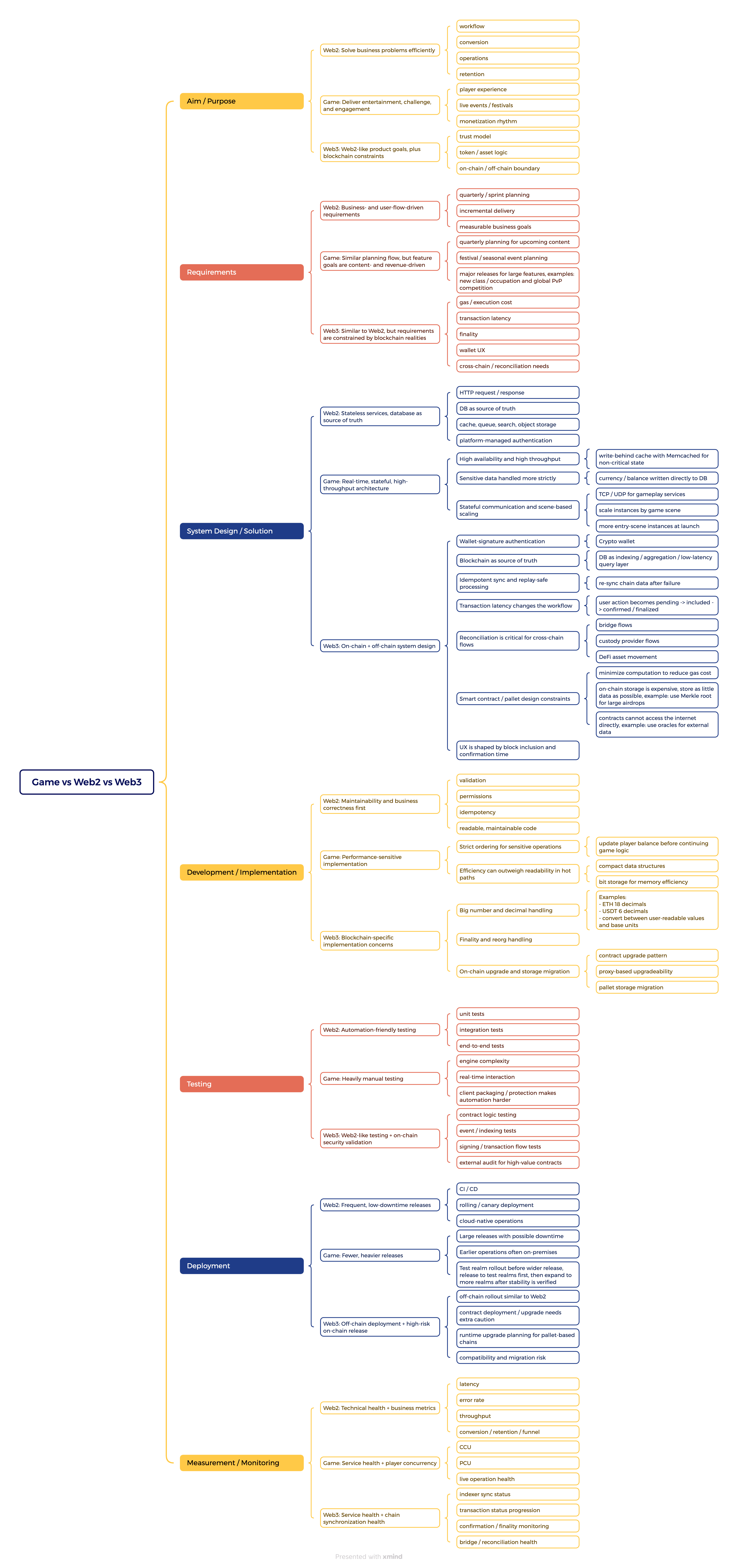
mindmap_games_web2_web3